
"God save the King..." (again)
Provocation: Is the national anthem dividing us when it should be uniting us?

This is a repost of a newsletter that we first published last year.
Given the World Cup has just started, it feels like a pertinent repost.
I think we can say that Flower of Scotland is a rousing anthem - latest evidence below!
On a recent project, Shaping the Nation for GroupM and Mindshare we had the privilege not only to work with some brilliant and lovely people, but also to discuss and debate the findings from all the research we were conducting within the working team.
One of the many areas we discussed with them as part of that work, that came up a bit in our conversations around the UK, was the subject of national anthems.
In this post, we’re going to use some of the quotes we gathered from our travels, take a leap and share some provocations about the passionate subject of national anthems.
(There are loads of studies about national anthems, and we just want to focus on a few elements that we picked up on during our travels around the UK.)
Will he sing or won’t he?!
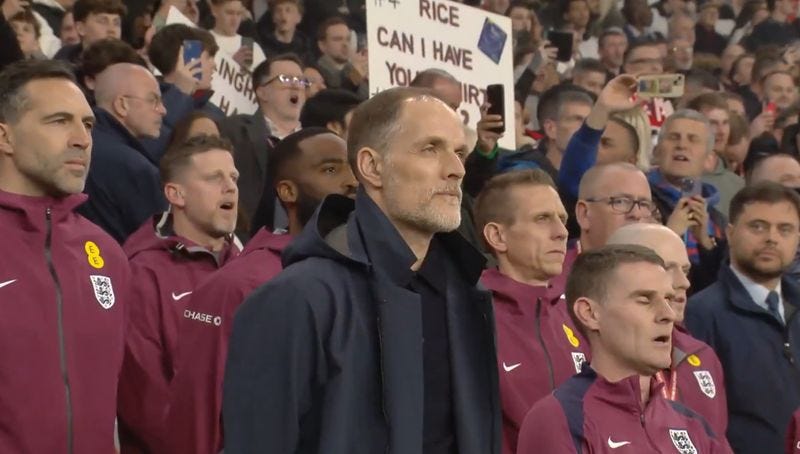
Recently, the UK national anthem was in the press and focused around football. Would Thomas Tuchel - the new England Men’s Football Team manager - sing it, he being German and all…
“God save the King” is the national anthem of the UK - but used predominantly by England as its anthem. England doesn’t have its own distinct national anthem, unlike Scotland and Wales.
But first… the difference between Nationalism and Patriotism
We had a really interesting chat with Finlay, who we met in Kelso on the Scottish borders about the differences between patriotism and nationalism:
“There is a difference between patriotism and nationalism. You can be fiercely patriotic and not necessarily be nationalistic. I'm a season ticket holder at Murrayfield. The boys come with me to Murrayfield, and we'll sing ‘Flower of Scotland’ as loud as we can.
I’m as patriotic as you can get, and yet I'm not a nationalist, and I think you can have a clear divide between the two. I think sometimes they get confused, and I think some nationalists feel betrayed if they see people as patriotic who haven't gone the full hog and become nationalist.
Whereas to me, nationalism is about putting up barriers between you and the other. And in Scotland's case, it would be putting up a barrier between us and England. Us and our biggest market. And my firm belief is that you should be taking barriers down, not building them up.
In this world, we shouldn't be putting barriers up. We should be breaking them down as much as we can. But you can break down those barriers and still have a healthy patriotism.”
So, put simply, what are the differences between Patriotism and Nationalism? ChatGPT tells us:
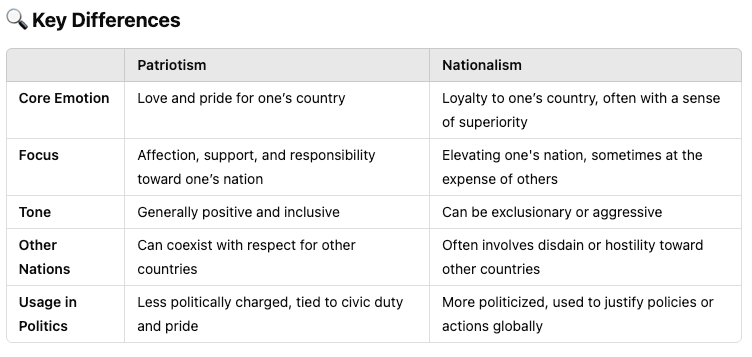
In (maybe overly) simplistic terms: Patriotism is positive and inclusive, Nationalism is negative and exclusive.
So - provocation - surely you’d want your anthem to be patriotic, and not nationalistic?
Wales and Scotland - lyrics and positivity about the people and the nation
When we’ve chatted to Welsh and Scottish people on our travels, we tend to hear variations on the theme of this quote:
“The Celtic in us [the Welsh]—and Ireland and Scotland—is something that draws us together. Unfortunately, that is not true of the English person.”
The Widowed Farmer now in town, Alwen in Llanfyllin, 80
For Alwen, there’s a clear sense of identity. Of what being Welsh, Scottish or Irish means. A pride of being united by the Celts.
Following this train of thought, let’s look at the lyrics to the Welsh and Scottish national anthems.
Let’s look at the lyrics of Hen Wlad Fy Nhadau (Land of My Fathers) - the (unofficial) national anthem of Wales:
This land of my fathers is dear to me
Land of poets and singers, and people of stature
Her brave warriors, fine patriots
Shed their blood for freedomChorus:
Land! Land! I am true to my land!
As long as the sea serves as a wall for this pure, dear land
May the language endure for ever.Old land of the mountains, paradise of the poets,
Every valley, every cliff a beauty guards;
Through love of my country, enchanting voices will be
Her streams and rivers to me.Chorus
Though the enemy have trampled my country underfoot,
The old language of the Welsh knows no retreat,
The spirit is not hindered by the treacherous hand
Nor silenced the sweet harp of my land.Chorus
It’s a love letter to the people and the land. It’s about the place, but it’s also about the people - those who have gone before them, the poets and singers and people of renown… the people who have made Wales what it is. It’s an appreciation of people past, and a passionate plea to those who embody the country now.
It has positivity flowing through it - we’d call it more of a patriotic anthem and less of a nationalistic anthem.
I defy anyone to watch this and not be moved:
Or Flower of Scotland - the (unofficial) national anthem of Scotland:
O Flower of Scotland,
When will we see your like again
That fought and died for
Your wee bit hill and glen.
And stood against him,
Proud Edward's army,
And sent him homeward
To think again.The hills are bare now,
And autumn leaves lie thick and still
O'er land that is lost now,
Which those so dearly held
That stood against him,
Proud Edward's army
And sent him homeward
To think again.Those days are past now
And in the past they must remain
But we can still rise now
And be the nation again!
That stood against him
Proud Edward's army
And sent him homeward
To think again.O Flower of Scotland,
When will we see your like again
That fought and died for
Your wee bit hill and glen.
And stood against him,
Proud Edward's army,
And sent him homeward
To think again.
It’s a defiant song, a middle finger to England. A battle cry of resistance. This is a song about agency. About people reclaiming themselves. Not waiting for anyone else’s permission.
Again, it’s a song about the people, owned by the people, sung by the people.
And boy, do they own that song:
So, what about England?
It seems for many, the English identity is the hardest one to pin down. And for those who can pin it down - in its modern guise - it has troubling associations.
This tension has emerged across multiple conversations over multiple projects.
It’s almost like Englishness is too loaded, too political, too tangled in guilt or embarrassment to be proudly claimed in the same way as Scottishness or Welshness.
England just seems too… complicated… compared to some other nations…
Can one song unify the patchwork of the UK?
The English national anthem is, strictly speaking, the UK anthem, and if ever a song was needed to pull together the nations into unity it’s now:
“I don’t think [the UK is] a whole unit. I don’t really think of it as a unit. I think of it as fractured.”
Moved About a Bit, Uma in Lewes, 27
“What does Britishness mean? That’s an impossible question to answer these days.”
Independent Seaside Shop Owner, Vanessa in Southwold, 51
“I’m not even British. I’m a human from planet Earth.”
The Community Kitchen Owner, Charlie in Tunbridge Wells
And whilst the Welsh and Scottish national anthems are a call to arms of the people, of positivity, of unity, the de-facto English national anthem isn’t about the people or the land at all.
It’s about religion and the monarchy.
God save our gracious King!
Long live our noble King!
God save the King!
Send him victorious,
Happy and glorious,
Long to reign over us,
God save the King.
Thy choicest gifts in store
On him be pleased to pour,
Long may he reign.
May he defend our laws,
And ever give us cause,
To sing with heart and voice,
God save the King.
It’s not about the people. It’s not about the land. It’s not about unity. It’s not even really about the country.
Whereas Scotland and Wales talk about the people, the land, freedom and agency, the de-facto English anthem talks about being ruled over - by two divisive subjects: God and King. And they’re both hugely polarising.
Religion is divisive:
In 2023, a King’s College study revealed only 49% of British people believed in God…
The monarchy is divisive:
In 2024 NatCen told us that only 54% of the British population think it’s ‘very’ or ‘quite important’ to have a monarchy.
So, the very first line of a song that is designed to bring together people ‘shoulder to shoulder’, to make them stand proud, to rally them and energise them… to unite them - has key elements that half of the population don’t agree with.
I think you could call that ‘missing the brief’ for a national anthem?
An opportunity for unity
The NatCen research above tells us that the percentage of the population believing it’s important to have a monarchy ‘is the lowest proportion to be recorded by the survey since it first asked the question in 1983’.
And we know through lots of research - including the great work Steve does at The Outsiders - that there is a deep love for the monarchy from the working classes.
But - is there something here about a country going through tough times, in need of some unity more than ever? Is there an argument to be made that as a nation - as a group of nations - we are facing existential threats like we haven’t for many generations?
We could mention Russia, China, the ‘new’ USA and what that means for our ‘special relationship’, the potential rise of fascism, tariffs, Brexit, pandemics, global recession, the economy, the ‘population explosion’, the climate crisis… the list goes on.
Each of those alone is a big deal and divide opinion in the UK, but group them together and there are enough areas to bitterly divide populations. And history tells us when populations are divided, that gives opportunities for extremism to rise.
Provocation: we are in need of unity like never before and a unifying anthem is a key part of that
If you buy any of the above then a strong, positive, powerful national anthem should sit at the heart of an attempt at unity.
A song that tries to find threads of connection between us, not focus on areas that polarise and split us down the middle.
Without a national anthem that unites, what do we have to bring us together? Without a shared song what puts us shoulder to shoulder?
Postscript: North London Forever
Since writing this, I keep thinking about Arsenal fans singing North London Forever.
Written by Louis Dunford and released in 2022, it is a relatively new song. And yet, within a few years, it has become part of the emotional fabric of the club. A song about place, belonging and shared identity, now sung by tens of thousands of people as if it had always been there.
One club, yes. One small part of the country, yes.
But It shows these things can be created. New songs can take root. New rituals can form. A community can find a voice, learn the words, and make it theirs.